Challenge

AI defaults to the internet’s average

AI coding tools default to the same generic UI: centered gradient heroes, icon-in-circle feature cards, Inter everywhere. I wanted my AI collaborator to design the way I would, so I built it a reference library and a written profile of my taste.
How it works

Capture, tear down, calibrate, design

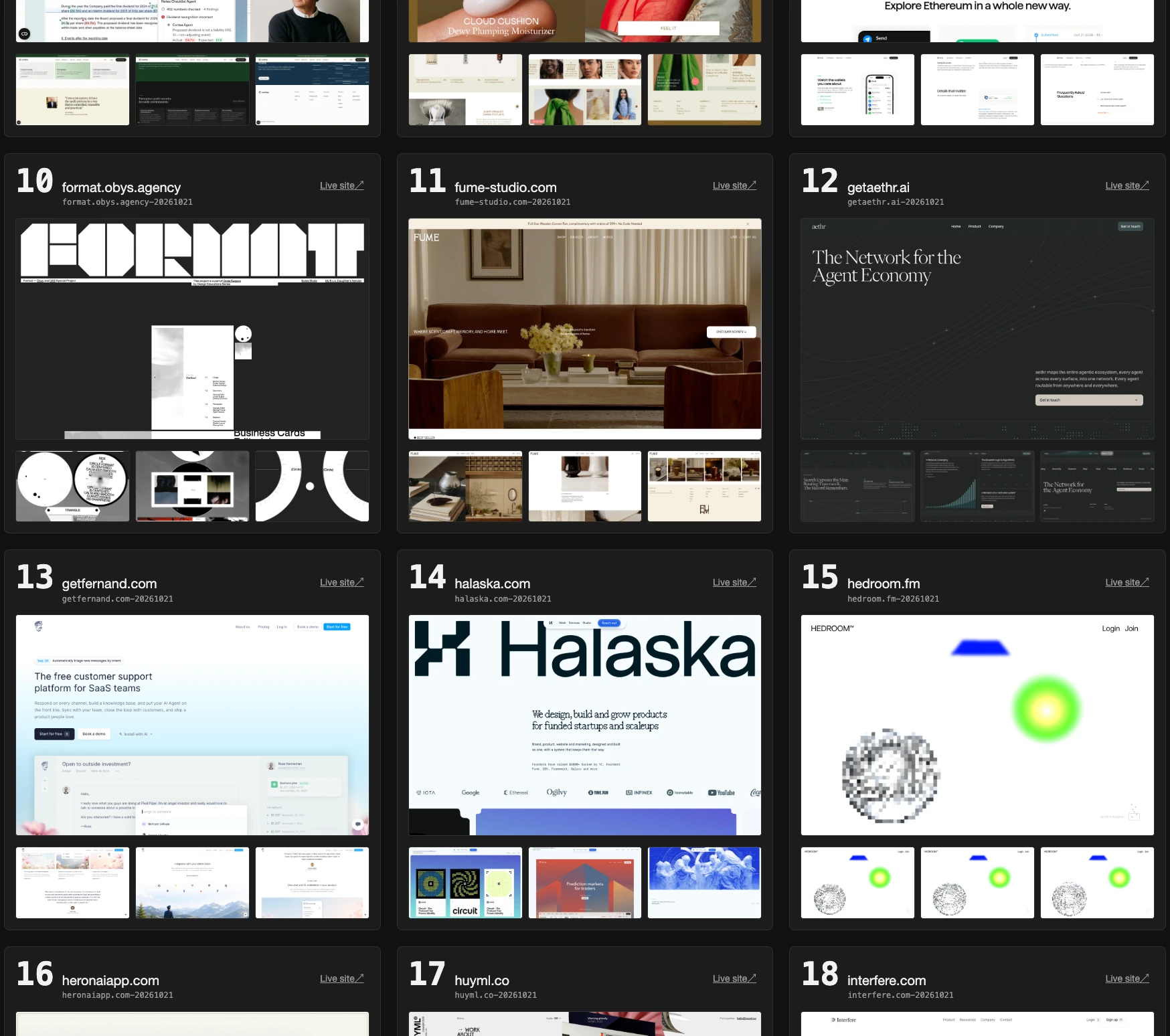
Inspo Kit gallery: numbered cards for captured sites such as format.obys.agency, fume-studio.com and getaethr.ai, each with a desktop screenshot and three scroll frames

Four steps

  • Capture: A Playwright script visits a live site the way a person would. It closes cookie banners and pop-ups, clicks through splash screens, scrolls in steps to trigger scroll animations, and hovers over key elements. It saves desktop and mobile screenshots, paired scroll frames that show motion, and hover states. It also records the site’s fonts, color palette, animation timing and front-end libraries.
  • Teardown: For each site, Claude writes a structured breakdown: what makes it work, layout, type, color, motion, how to rebuild the signature details, and a risk score from conventional to experimental.
  • Calibrate: A numbered gallery lets me react in one pass (“12 👍 sharp dark UI, 17 👎 unintuitive”). Those reactions become testable rules, such as “at most one scroll-driven sequence per page” or “no custom cursors”, plus a list of banned defaults.
  • Design: When I start a project, Claude identifies the project type, pulls matching references, and proposes three distinct directions. Before showing me anything, it checks its own work against my rules.
Setting it up

50 sites, 43 ratings, and one key nuance

I seeded the library with 50 live sites from Awwwards, Godly, Siteinspire, Codrops and Land-book, then rated 43 of them.

That surfaced a key nuance: my taste depends on context.

A clean, credible business aesthetic is right for a B2B showcase, not for every project. So the profile separates rules that always apply from rules for business sites, portfolios, and photo-led storytelling.

Finally, I reconciled the profile with my existing design standards for type scale, motion timing and spacing, so every project draws on one consistent set of rules.

Result

A taste engine for AI-assisted design

An AI design partner that starts from my judgment instead of the internet’s average.